
BIOBRIDGE PL-SK


BIOBRIDGE PL–SK – Green Bridge: Protection of Forest Biodiversity in the Carpathian Borderlands
The BIOBRIDGE PL–SK project is co-financed by the European Union through the European Regional Development Fund under the Interreg Poland–Slovakia 2021–2027 programme.
Duration: 1 June 2026 – 31 May 2028
Budget: Total eligible costs €1,405,656.95; EU contribution €1,124,525.56; co-financing €281,131.39.
Project partners: National Forest Centre / LignoSilva Centre of Excellence (Lead Partner), LESY Slovenskej republiky, š. p. (State Forests of the Slovak Republic) https://www.lesy.sk/, Lasy Państwowe – Nadleśnictwo Łosie (State Forests – Łosie Forest District) https://losie.krakow.lasy.gov.pl/
Project objective: Under Priority 1, Specific Objective 2 of the programme, the project focuses on the protection, restoration, and increased resilience of forest ecosystems in the Carpathian border region through research, practical field measures, and environmental education.
Main project activities: The project implements specific measures to support biodiversity in border forests. A key focus is the protection of the European yew (Taxus baccata), including enhanced protection of selected sites and support for its regeneration. Activities also include underplanting and planting of native tree species that are “rare or missing from the current species composition” (particularly fir and valuable broadleaved species), as well as subsequent care for young stands (protection against weeds and game, and tending interventions). The NLC will supply a portion of seedlings grown in polytunnels using substrates enriched with cellulose sludge and wood ash, thereby linking biodiversity restoration with circular economy principles.
A key component involves the joint monitoring of the health of fir stands (ground-based assessments in Slovakia; remote sensing via UAV, LiDAR, and satellite in Poland—particularly regarding mistletoe occurrence) and the effective removal of the invasive Japanese knotweed (Fallopia japonica) at selected sites. The project is complemented by educational and outreach activities, including the installation of educational features within the Becherovská Tisina National Nature Reserve and in Wysowa-Zdrój, as well as field training, forest education programs, and excursions.
Further information: ongoing updates and project outputs will be published on the project’s and partners’ websites and communication channels.
The BIOBRIDGE PL–SK project focuses on the protection, restoration and increased resilience of forest ecosystems in the Polish-Slovak border area. It combines research, practical field measures, modern monitoring and environmental education to support biodiversity in the Carpathian borderlands.
The project is implemented by three partners: the National Forest Centre, LESY Slovenskej republiky, state enterprise, and Nadleśnictwo Łosie.
basic description
BIOBRIDGE PL–SK creates a Slovak-Polish partnership focused on the protection of forest biodiversity in the Carpathian borderlands. Its objective is to strengthen the ecological stability of forest ecosystems, support native tree species, protect rare species and introduce modern approaches to forest health monitoring.
The project combines scientific research, practical forest measures, invasive species removal, support for natural tree species composition and environmental education. The results will be useful for forestry practice, nature conservation, cross-border cooperation and raising public awareness of the importance of biodiversity.
Project duration: 01. June 2026 – 31. May 2028
Budget: total eligible expenditure 1 405 656,95 EUR, grant 1 124 525,56 EUR, co-financing 281 131,39 EUR.
objectiv and area
partners
National Forest Centre – lead partner / research and coordination
The National Forest Centre coordinates the project and ensures expert background documents, methodologies and the quality of outputs. It carries out research, ex-situ protection and cultivation of yew, prepares planting material and integrates data from silver fir stand monitoring. In this way, it supports expert decision-making and measures aimed at protecting and enhancing the biodiversity of borderland forests.
Website and contact information: https://web.nlcsk.org/
LESY Slovenskej republiky, state enterprise – Slovak partner / measures in borderland forests
LESY Slovenskej republiky implements practical measures to support biodiversity in Slovak borderland forests: underplanting of native tree species, protection of young stands against weeds and game damage, cleaning and stand hygiene. It is also involved in the removal of invasive Japanese knotweed and in making the area accessible through an educational trail leading to the Becherovská Tisina National Nature Reserve.
Website and contact information: https://www.lesy.sk/
Nadleśnictwo Łosie – Polish partner / measures in Natura 2000 areas
Nadleśnictwo Łosie implements practical measures to support biodiversity in the Polish part of the border area: protection of yew localities, biodiversity-supporting plantings and protection of young silver fir stands. It provides remote monitoring of silver fir and mistletoe using UAV/LiDAR/satellite data, participates in the removal of invasive Japanese knotweed and prepares an educational trail in Wysowa-Zdrój.
Website and contact information: https://losie.krakow.lasy.gov.pl/
expected results
European yew
1. European Yew – Protection, Genetics and Restoration
European yew (Taxus baccata) is one of the rare and ecologically important tree species of the Carpathian region. The project focuses on its protection through genetic research, morphometric assessments, ex-situ conservation, seedling cultivation and direct protection of selected localities.
The National Forest Centre carries out expert activities focused on genetics, cultivation and the future use of yew in the restoration of forest biodiversity. The activity also includes the cultivation of 200 yew seedlings of Polish provenance in NFC facilities.
The Polish partner ensures the protection of natural yew localities, including the renewal and improvement of protective elements in the field. The common objective is to strengthen the long-term viability of yew in borderland forest ecosystems.
native trees
2. Native Tree Species and Biodiversity of Borderland Forests
This activity supports native tree species with low representation in the current species composition and practical measures that increase the species, structural and ecological diversity of borderland forests.
In the Slovak part of the project, activities will include underplanting, protection of young forest stands against weeds and game damage, cleaning, stand hygiene and other silvicultural measures. The National Forest Centre prepares part of the planting material grown in modern facilities.
In the Polish part of the project, biodiversity-supporting plantings and protection of young silver fir stands will be implemented. The common objective is to support the stability, resilience and biodiversity of forest ecosystems through native tree species and close-to-nature approaches.
silver fir monitoring
3. Silver Fir Monitoring – Keeping Forest Health Under Control
Silver fir is an important tree species of the Carpathian forests, and its health condition is an important indicator of forest ecosystem stability. The project connects ground-based monitoring on the Slovak side with remote monitoring on the Polish side.
In Slovakia, monitoring will focus on field assessment of the health condition of silver fir stands, including game damage and other factors influencing tree vitality. In Poland, remote sensing using UAV, LiDAR and satellite data will be applied, with particular attention to the occurrence of mistletoe.
The outputs will include data and map products useful for assessing the health of silver fir stands, identifying risk areas and planning further measures to support biodiversity and forest resilience.
Japanese knotweed
4. Invasive Japanese Knotweed – Testing Effective Removal Methods
Japanese knotweed (Fallopia japonica) is an invasive species that negatively affects natural habitats, displaces native vegetation and reduces biodiversity in affected localities.
The project focuses on testing and practical verification of effective removal methods. Experimental plots will be established to compare several approaches to eliminating Japanese knotweed.
Both Slovak and Polish partners are involved in this activity. The results will be documented continuously through photographs, particularly by comparing the condition of sites before, during and after the implementation of measures.
educational trails
5. Educational Trails and Biodiversity Education
The project connects expert field activities with environmental education and the public presentation of knowledge. The aim is to demonstrate the importance of borderland forest biodiversity, rare tree species protection and practical measures directly in the project area.
On the Slovak side, the educational component will be linked to an educational trail leading to the Becherovská Tisina National Nature Reserve. On the Polish side, an educational trail will be prepared in Wysowa-Zdrój.
The activity will include information elements, educational panels, QR content, excursions, field training and events for both professional and general audiences.
preparation
6. Project Preparation and Partnership
The preparatory phase created the basis for the successful implementation of joint activities. It included the establishment of the Slovak-Polish partnership, harmonisation of project intentions, preparation of the budget, timetable, mandatory annexes and project application.
This stage set the expert, organisational and financial framework of the project and prepared the conditions for the implementation of practical measures, monitoring, research and communication activities.
communication
7. Project Communication, Events and Outputs
Project communication ensures continuous information sharing with the public, experts and partners about the objectives, activities and results of BIOBRIDGE PL–SK.
Communication activities include website outputs, information materials, conferences, excursions, media outputs, videos, articles and other forms of result dissemination. Special attention is given to joint partner events, the opening conference, field activities and the final presentation of project results.
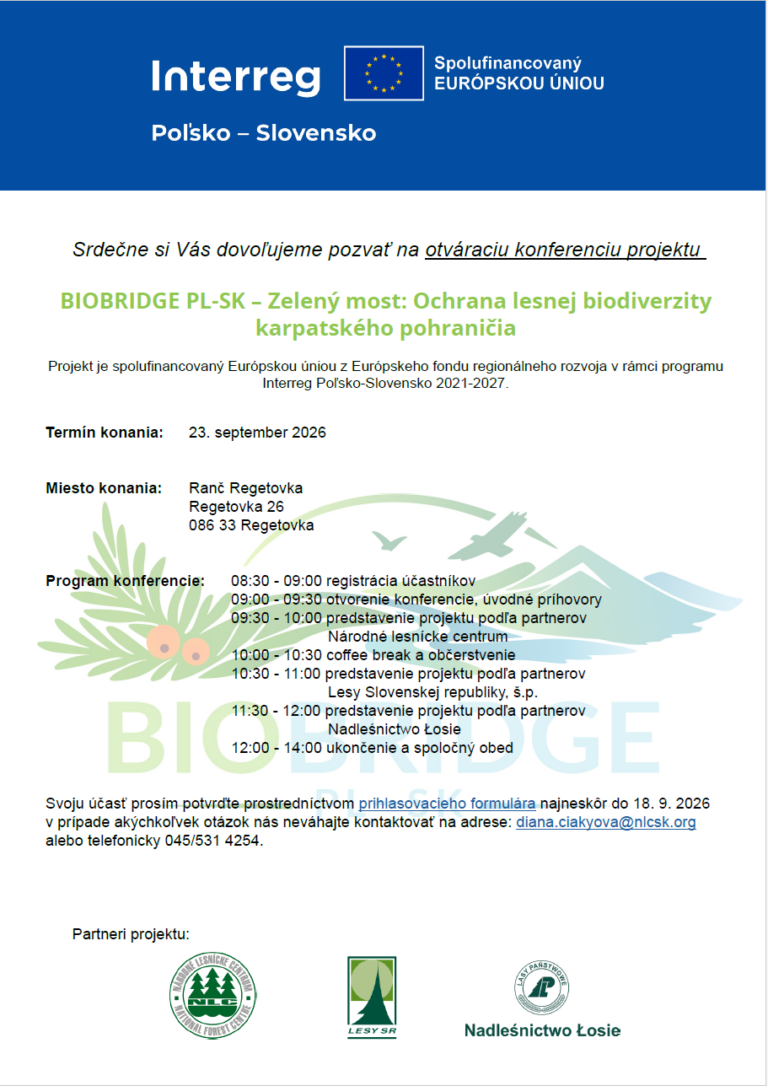
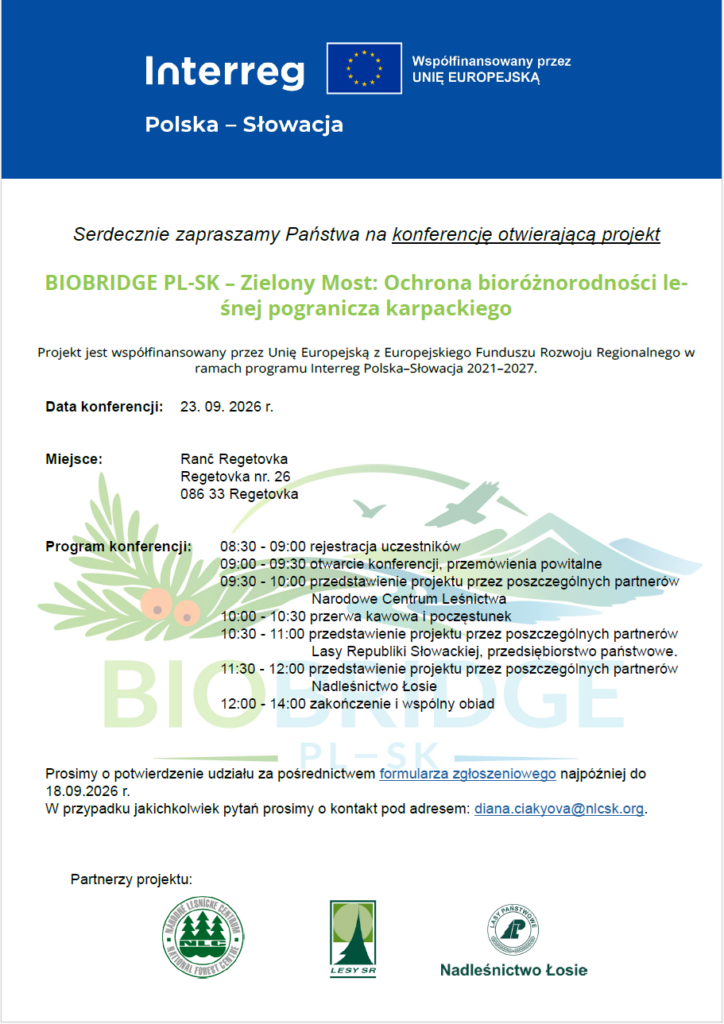
Pozvánka na otváraciu konferenciu projektu BIOBRIDGE PL-SK
This section documents the implementation of BIOBRIDGE PL–SK through photographs from the field, laboratories, cultivation facilities, monitoring activities, plantings, educational events and purchased infrastructure.
The photo documentation transparently presents specific measures supporting biodiversity in the Carpathian borderlands and the ongoing outputs of the project.
infrastructure and equipment
Photographs of purchased equipment, laboratory tools, monitoring devices, field equipment and educational elements.
field measures
Plantings, underplantings, protective elements, fencing, cleaning, stand hygiene and measures against invasive species.
monitoring
Ground-based silver fir monitoring, monitoring plots, camera traps, field equipment, UAV/LiDAR/satellite outputs and map products.
European yew
Yew seedlings, cultivation, laboratory work, genetic analyses, ex-situ conservation and protection of localities.
education and public
Educational trails, information panels, workshops, excursions, forest pedagogy and project events.
Information will be updated regularly.
projects meetings
1. Opening Project Meeting
The partners of the BIOBRIDGE PL–SK project will meet at the kick-off event to present the main activities, establish coordination, and prepare the next steps for project implementation.
plantings and field work
Delivery of Yew Seedlings of Polish Provenance
As part of the project, 200 yew seedlings of Polish provenance were obtained. The seedlings were placed in NFC cultivation facilities, where their further cultivation and expert monitoring are taking place.
monitoring
Preparation of Silver Fir Stand Monitoring
NFC is preparing ground-based monitoring of the health condition of silver fir on the Slovak side. The Polish partner is preparing remote monitoring of silver fir and mistletoe using modern remote sensing technologies.
invasive species
Preparation of Experimental Plots for Knotweed Removal
Experimental plots will be established within the project to test several methods of removing invasive Japanese knotweed.
educational activities
Information will be updated regularly.
information materials
Leaflets, posters, presentations and other project information materials.
methodologies and expert outputs
Methodological documents, expert reports, monitoring results and recommendations for practice.
map outputs
Maps, GIS outputs and spatial data from monitoring and field activities.
video and photo documentation
Selected photographs documenting project implementation, purchased infrastructure and measures in the field.